Wednesday, January 11, 2017

Lydia Ann Marquis McDanel

Lydia Ann Marquis McDanel
born: 19 Feb. 1842 in New Brighton, Beaver County, Pennsylvania
died: 18 Nov. 1928 in Detroit, Michigan
buried: Grove Cemetery, New Brighton, PA
father: James M. Marquis (1814-1880)
mother: Elizabeth Sawyer (1813-1846) 
husband: Richard Baxter McDanel (1844-1912), married 19 March, 1868
children: Frederick (1868-1926), Lewis (1870-died young), Bertha (1871-1957), Frank (1873-1932), Orrin Palmer (1879-1932), Richard Baxter Jr. (1880-1956), Elizabeth Lydia (1882-1925), Anna (1887-1948)

Lydia is my great-great grandmother. Here is information about her father and grandfather:

“James Marquis, a farmer and coal dealer, was a son of Joseph Marquis, a native of England, a minister of the Methodist Episcopal church, and a printer, the latter occupation being necessary to eke out the small and uncertain salary of the member of the clergy in that day. James Marquis married (first) Elizabeth Sawyer, (second) Mary Knowles.  [SOURCE: John W. (John Woolf) Jordan. Genealogical and personal history of Beaver County, Pennsylvania (Volume 2). page 47 of 7] 

After Baxter’s death, she lived in Detroit with her daughter Anna until her death in 1928. 


Lydia (oldest woman, seated at right) is shown here with her husband and her children.

Detail from family shot above.


I believe Lydia could be the oldest woman in the back, in the hat, in this photo. Her son, Frederick, my great-grandfather, is the man in the back. 


Wednesday, August 24, 2016

Military service

The following men who are my ancestors served in the American armed forces. There may be more; this is a working list.

American Revolutionary War:
John Brubaker (1754-1803), my fourth great grandfather (paternal)
married Anna Musser (1757-1817)
Private, Fourth Class, Fifth Company of the First Battalion of Lancaster County Militia, 1777

Robert Philson (1759-1831), my 4th great grandfather (paternal)
Somerset County, PA
Arrested 1794 for involvement in the Whiskey Rebellion, later acquitted in Philadelphia.
Rose to Brigadier General in the War of 1812.
Later served as the US Representative from Pennsylvania (1819-1821).
SOURCES: https://en.wikipedia.org/wiki/Robert_Philson
http://www.findagrave.com/cgi-bin/fg.cgi?page=gr&GRid=29205289
http://bioguide.congress.gov/scripts/biodisplay.pl?index=P000316
http://www.waymarking.com/waymarks/WM94FD_General_Robert_Philson

Joseph Sherer (1731-1776), my sixth great grandfather (paternal)
From a Sons of the American Revolution application: “During the French and Indian War Jospeh Sherer served as a non-commissioned officer and was in active service as a Scout or ranger on the frontiers. When the thunder of the Revolution reverberated along the valley of the Susquahana, with all his Scotch and German neighbors he inlisted into the contest for liberty. In 1775 and 1776 he was Captain of a company of Col James Burds 4th Battalion of Associates of Lancaster County Pennsylvania. 1st Lieut James Collier 2nd Liet James Rutherford, Ensign Samuel Hutchenson. Captain Sherer was a member of a committee of Observation for the County of Lancaster, and was chosen by a vote of the people a member of the First Constitutional Convention of the State of Pennsylvania which met at Philadelphia on the 15th of July 1776. While in attendance in this representative body of Revolutionary era, he took ill returned home and died on the first of December.”

Joseph Brady (1735-1787), my 5th great grandfather (maternal)
Captain, Cumberland County, PA
Captain of the 7th Company, 1st Battalion of Cumberland County Associators.
Commissioned in July 1777, and saw service throughout the war


John B. McClelland (1734-1782), my 5th great grandfather (maternal)
Captain, Westmoreland County, PA. At the Siege of Yorktown.
From Wikipedia: “At the outset of the Revolutionary War, McClelland was appointed to a citizen’s committee to procure arms and ammunition for the defense of the struggling new nation. He enlisted in the Fourth Pennsylvania Battalion, on January 28, 1776, which worked in conjunction with the Continental Army during the war. McClelland later became a Captain in the First Battalion of Westmoreland Militia, a unit which was prominent in the Siege of Yorktown.” He was a member of the Pennsylvania Constitution of 1776, and later represented Westmoreland County in the Pennsylvania General Assembly. Tortured to death by native Americans during the Crawford Expedition.
SOURCES: https://en.wikipedia.org/wiki/John_B._McClelland
https://sites.google.com/site/johnbmcclellandmemfdn/
http://www.findagrave.com/cgi-bin/fg.cgi?page=gr&GRid=79587863

William Alexander (1757-1835), my 4th great grandfather (maternal)
Private, Chester County, PA. Crawford Expedition (served with John B. McClelland)
Married Elizabeth McClelland, John B. McClelland’s daughter.

William Linn (1748-1813), my 5th great grandfather (maternal)
Private, Cumberland County, PA. Served in the Pennsylvania Militia under Capt. Charles Maclay’s Company and Col. James Dunlap’s regiment.
SOURCE: Sons of the American Revolution membership application by Dr. Bernard Ross Pinckney (1949)

John B. Powelson (1746-1822), my 5th great grandfather (maternal)
evident suggests he served in the Fourth regiment, New Jersey
married Sophia Barber (1742-1819)

James Moore (1747-1833), my 5th great grandfather (paternal)
Born Londonderry, Rockingham, New Hampshire
Died New Brighton, Beaver County, PA
Married Isabella Stewart (1764-1853)

William Scott (1738-1833), my 6th great grandfather (maternal)
Served April - October 1778 in Col. Courtlandt's Regiment, N.Y. line, according to PA Veteran's Burial Cards
Buried Union Cemetery, Smithfield Township, Bradford PA


War of 1812:
Robert Philson (1759-1831), my 4th great grandfather (paternal)
Brigadier General, Somerset County, PA
later served as the US Representative from PA
(See info above)

John Brubaker (1779-1853), my 3rd great grandfather (paternal)
Major (rose from 1st Lieutenant), Berlin County, PA

MILITARY: Twelfth Division, 1812-1814, Bedford, Somerset & Cambria Counties, PA

Contributed for use in the USGenWeb Archives by Judy Banja <jbanja@msn.com>

Copyright.  All rights reserved.
http://www.usgwarchives.net/copyright.htm
http://www.usgwarchives.net/pa/bedford/
________________________________________________

                            Pennsylvania Archives
                                Sixth Series
                                 Volume VII
                      Edited by Thomas Lynch Montgomery
                          under the direction of the
                              Hon. Robert McAfee,
                        Secretary of the Commonwealth.
      Harrisburg, Pa.: Harrisburg Publishing Company, State Printer, 1907. 
INSPECTION ROLL OF THE BERLIN RIFLE COMPANY ATTACHED TO THE FIRST BATTALION 109TH REG'T 
PENN'A MILITIA WHO HAVE VOLUNTEERED THEIR SERVICES, IN SUBSTITUTION OF THE DRAFT 
REQUIRED FROM SAID REGIMENT.

One drum.
A. Rifle.             E. Tomehawk's.
B. Smooth rifle.      F. Pouch & horn.
C. Worms.             G. Belts. 
D. Butcher knife.     H. Uniform 

                                         A.      B.      C.      D.      E.      F.      G.      H
1       Capt. Casper Keller,                                                                     1
2       1st Lieut. John Brubaker                                                                1


Civil War:

Thomas A. Braden (1844-1911), my 2nd great grandfather (paternal)
17th Cavalry, 162nd Regiment, Pennsylvania volunteers Company A, Beaver County, PA


Richard Baxter McDanel (1844-1912), my 2nd great grandfather (paternal)
Company C, 63rd Regiment Pennsylvania Volunteers, Beaver County, PA


Jacob Osmon Funkhouser (1839-1907), my 2nd great grandfather (maternal)
Company C, 134th Regiment Pennsylvania Volunteers, Beaver County, PA


Isaac Warren (1838-1922), my 2nd great grandfather (maternal)
202nd Regiment Pennsylvania Volunteer Infantry


Joseph Martin DeVenny (1840-1920), my 2nd great grandfather (paternal)
Company H, Pennsylvania 38th Infantry 


James Cowling (1810-1881), my third great grandfather (maternal)
Private in the 77th Regiment Pennsylvania Volunteer Infantry, Company D. Discharged honorably for disability. Served 10 months. Saw action at Murfreesboro (late December 1862) and the Battle of Shiloh (also known as the Pittsburg Landing) in southwestern Tennessee, on
April 6–7, 1862.

I also suspect, but do not have confirmation yet, on these two:


Thomas Carter (1842-1913), my 2nd great grandfather (maternal)
Bucks County, PA (Union) OR Amelia Courthouse, VA (Confederate)


Dr. Henry Brubaker (1827-1889), my 2nd great grandfather (paternal)
Somerset County, PA – a physician – may have served in this capacity

World War I:

Joseph DeVenny Brubaker (1897-1978, my paternal grandfather)
served as a Marine in Haiti

Monday, March 30, 2015

DNA results

2022 Ancestry.com DNA results:
45% Scotland
36% England and Northwestern Europe
9% Ireland
9% Germanic Europe
1% Finland

2020 Ancestry.com DNA results:
41% Scotland
34% England and Northwestern Europe
16% Ireland
8% Germanic Europe
1% Finland

2019 Ancestry.com DNA results:
59% England, Wales and Northwestern Europe

32% Ireland and Scotland
8% Germanic Europe
1% Finland


2018 Ancestry.com DNA test results:
45% England, Wales and Northwestern Europe

37% Ireland and Scotland
17% Germanic Europe
1% Finland

Here are the results of my 2015 Ancestry.com DNA test:

64% Western Europe
31% Great Britain (England, Scotland, Wales)
3% Ireland
1% Finland/Northwest Russia
<1% Iberian Peninsula

My husband, Robert Dale Knapp, also took the test. Here are his results:
44% Western Europe
25% Ireland
13% Great Britain (England, Scotland, Wales)
11% Iberian Peninsula
5% Eastern Europe
1% Scandinavia
<1% Finland/Northwest Russia
<1% Italy/Greece

Wednesday, September 3, 2014

Joseph DeVenny Brubaker, Sr.


Joseph DeVenny Brubaker, Sr.
born: 12 July 1897 in Beaver County, Pennsylvania
died: 6 Sept. 1978 in Beaver County, Pennsylvania
buried:  Beaver Cemetery and Mausoleum, Beaver, PA
father: Edwin Schall Brubaker (1864-1939)
mother: Carrie Josephine DeVenny (1871-1925) 
wife: Helen Marquis McDanel (1897-1958), married 24 August 1921; Gertrude Wagoner (1916-2003), married about 1960.
children: Joanne (born 1931, died at birth), Joseph DeVenny Brubaker, Jr. (b. 1933), and John Robert “ Bob” Brubaker (b. 1935)
siblings: Sarah Elizabeth Brubaker (1896-1971) and a half-brother by Edwin's first wife, Henry Sampson Brubaker (1890-1969)

Joseph DeVenny Brubaker, Sr. is my paternal grandfather. He was the second child of Edwin Schall Brubaker and his second wife, Carrie Josephine DeVenny, and was reared in New Brighton, Pennsylvania. 
Joe and his sister Sarah Elizabeth
As a teenager, Joe worked in his father’s pharmacy as a soda jerk.  In this photo, he is shown with his father (on the left), in front of the store:


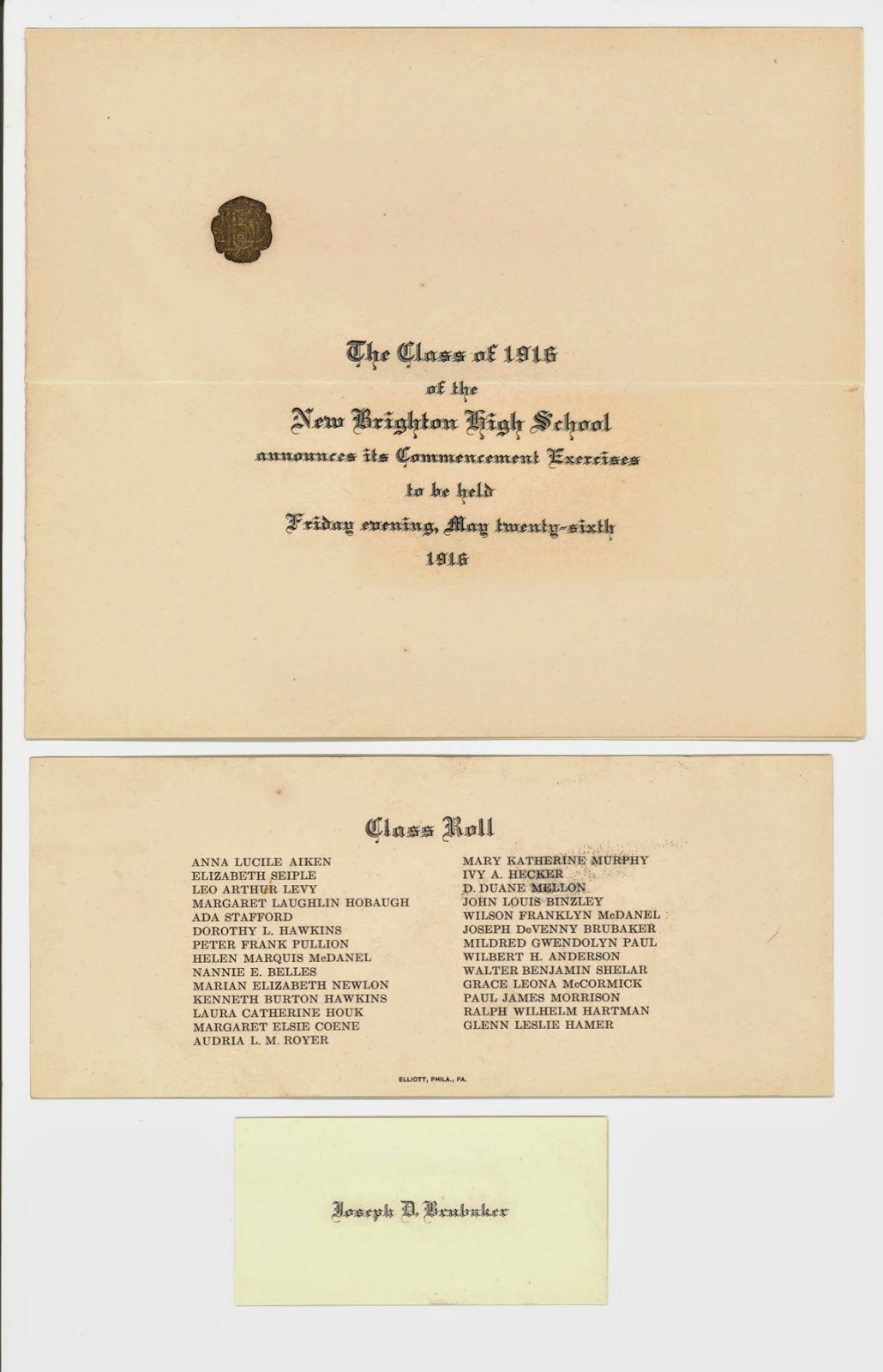
He graduated from New Brighton High School in 1916. This photo from my grandmother Helen’s photo album shows her with Joe (second from left), her sister Marion, Shad (Marion’s husband), and John (the driver). This photo was probably taken about 1916.


He served in the Marine Corps in Haiti during World War I, where he contracted malaria. My father says he never could drink gin after that, as it reminded him of the quinine treatment he received. Some of the history of the U.S. involvement in Haiti during this time is covered on Wikipedia.


Upon returning to Beaver County, Joe worked as a bank teller and married his high school sweetheart, Helen Marquis McDanel, on 24 August 1921. He worked his way up into bank management, and they had three children (the first, JoAnne, died at birth in 1931).  

Joe was an avid golfer, and was very artistic.  


Helen owned these two houses, and Helen and Joe raised their two boys in one of them.
Joe Brubaker in the 1940s.
Helen and Joe with Joe Jr. (top) and Bob, about 1947
Joe with Helen, possibly at a favorite vacation place, Lake Chataqua


Joe (left) at Lake Chataqua in the 1940s.
With Helen, possibly at Bob and Ellie’s wedding in 1957
4 N. Old Oak Drive, Patterson Heights
Joe with me, probably Christmas 1964
After Helen’s death in 1958, Joe met Gaby Wagoner while on a cruise to Hawaii, and married her.  I believe it was her second marriage, but have had no success in finding details of it. 

Gertrude “Gaby” Brubaker, Joe’s second wife
Joe died in 1978.


Transcription:
Joseph Brubaker, Ex-Banker, Dies
Beaver Falls –  Joseph D. Brubaker Sr., former director and vice chairman of the board of Century National Bank and Trust Co., of Rochester, Pa., died yesterday at his home. 

Mr. Brubaker, 81, of North Old Oak Drive, Patterson Heights, also was former director and treasurer of Tower Federal Savings and Loan Association abdn past president of the Beaver County Bankers Association. Mr. Brubaker was a member of the First Presbyterian Church, New Brighton, Beaver Valley Country Club, Pittsburgh Athletic Association, and several community organizations. 

Surviving are his wife, Gertrude; two sons, Joseph D. Jr. of Glenrock, NJ, and Robert of Mt. Lebanon, and seven grandchildren. 

Friends will be received from 7 to 9 tonight and from 2 to 4 and 7-9 p.m. tomorrow at Donald D. Druschel Funeral Home, 1612 Third Ave., New Brighton. Services will be at 10:30 a.m. Saturday at the First Presbyterian Church, Third Avenue, New Brighton.

Burial will be in Beaver Cemetery, Beaver.

Tuesday, September 2, 2014

Frederick McDanel (1868-1936)


Frederick McDanel
Frederick McDanel
born: 1 Sept. 1868 in New Brighton, Beaver County, Pennsylvania
died: 21 July 1926 in New Brighton, Beaver County, Pennsylvania
buried:  Beaver Cemetery and Mausoleum, Beaver, PA
father: Richard Baxter McDanel (1844-1912)
mother: Lydia Ann Marquis (1842-1928) 
wife: Francis Effie Braden (1869-1939), married 1 April 1891
children: Marion Etta “Mac” McDanel (1895-1948, married Clarence W. “Shad’ Gordon), and Helen Marquis McDanel (1897-1958, married Joseph DeVenny Brubaker)

Frederick (left) with two of his brothers, possibly Frank S (center) and Orrin Palmer (right).
Frederick and Effie are my paternal great-great-grandparents. Frederick grew up as the son of lumber store owner and contractor Richard Baxter McDanel, and eventually became Vice President and then President of the company. His brothers Orrin Palmer (1879-1953) and Frank S.  (1873-1932) and Richard Baxter, Jr. (1880-1956) also helped run the company, as evidenced from this 1912 ad:


This postcard photo shows the business flooded along the Beaver River March 27, 1913:


The charm (below) on my mother’s bracelet was a mystery until I found her notes. It is commonly called a “love token,” and was made from a 2-1/2 dollar gold coin in the late 1800s. According to my mother’s notes, it is supposedly the first money ever earned by Frederick McDanel. The back of the coin was smoothed down and hand engraved with his initials, FMcD. It is possible that this is the coin Frederick is wearing on his lapel in the McDanel family photo below, as well as the portrait of him at the top of this post.


In this family photo, probably taken in the early 1900s, Frederick is shown standing in the back, directly behind his father, Richard Baxter, Sr.

McDanel family, probably early 1900s. Photo is not labeled, but I think these identifications are correct. Front row, seated: Bertha, Richard Baxter Sr., Richard Baxter Jr., Anna, Lydia Ann Marquis McDanel. Back row (mostly standing): Frederick, Frank S., Elizabeth and Orrin Palmer. Lewis McDanel, born 1870, was said to have died young.
Frederick McDanel, later in life

Francis “Effie” Braden, Frederick’s wife.
I believe the man in this this photo may be Fred McDanel. The older woman in the back on the right may be Fred's mother, Lydia Ann Marquis McDanel, and the other older woman (left, in front row) may be Effie. The child could be Fred M. Gordon (b.1922), the son of Marion McDanel and Clarence "Shad" Gordon — Fred and Effie's first grandchild, and Lydia's first great-grandchild.
Frederick died at age 57. Here is the transcription of Frederick’s obituary taken from a copy of the Beaver Falls Tribune, 21 and 22 July 1926:


Transcript of Fred McDanel’s Obituary
from the Beaver Falls Tribune, July 21, 1926

Fred McDanel, president and treasurer of the Fred McDanel Lumber Company of New Brighton entered the hospital at ________:20 pm Tuesday evening__________. Mr McDanel was 58 years of age and a lifelong resident of New Brighton. He was always active in the best interests of the community and his loyalty to his principles and honesty and integrity won for him the highest esteem of his associates. He was a member of the Pittsburgh commandery No. 1, Knights Templar, Syria Temple Shrine, Harmony Chapter 206, R.A.M., consistory of New Castle, Union Lodge 259, F. & A. M, held at New Brighton, B.P.O.E. of Beaver Falls, Beaver Valley Council U.C.T. of America, No. 464; and the Community Club of New Brighton. He was the president of the board of education of which he had been a member of 23 years, a director of the Beaver County Trust company, also a director of the Second New Brighton Building & Loan Association. He leaves his wife, Effie Braden McDanel and two daughters, Marion Gordon of Beaver and Helen Brubaker of New Brighton; also his mother, Mrs. R.B. McDanel of Detroit.  Two sisters and three brothers also survive. The time of the funeral services will be announced later.

Transcript of Fred McDanel’s Funeral
from the Beaver Falls Tribune, 22 July 1926

Services for the late Fred McDanel will be held at the family home, 620 Sixth Avenue, New Brighton, Friday afternoon at 2 o’clock, Rev. Robert Axtell, pastor of the First Presbyterian chruck, officiating. Burial will be in Beaver Cemetery.


Tuesday, August 26, 2014

Captain Sam Brady

 Captain Brady

Captain Samuel Brady
born: 5 May 1756 in Shippensburg, Cumberland County, PA
died: 1795 in Short Creek, VA (now WV)
buried: West Liberty Cemetery, West Liberty, Ohio County, WV

father: Captain John Brady (1739-1779)
mother: Mary Quigley (1735-1783)
wife: Drusilla VanSwearington (married 1873)
children: William (b. 1785) VanSwearingen Brady (1786-1859) and John Brady (1790-1872)

Samuel Brady is my first cousin, six times removed. His father (John Brady) and my 5th great grandfather (Joseph Brady) were brothers. He served in the Revolutionary War, and fought in the battles of Boston, Princeton, Brandywine and Monmouth, and commanded scouts for General “Mad Anthony” Wayne. There is a long entry on Samuel on Wikipedia.

I copied the following information (without editing) from the online site Heritage History. (I do not know how much of this is true; it is written in a very colorful style and has several historical inconsistencies, but it is an interesting read.)

Captain Brady Swears Vengeance
(1780-1781)

and Broad-Jumps Like a Wild Turkey

Samuel Brady the Ranger: the Captain of Spies, the Hero of Western Pennsylvania—he indeed was a famous frontier fighter in the years following the Revolution, when the Indians were determined that “no white cabin shall smoke beyond the Ohio.” The struggle to keep the settlers out of present Ohio and Indiana (the Northwest Territory) proved long and bloody.

In western Pennsylvania and northern Ohio the name Captain Samuel Brady ranks with that of Daniel Boone in Kentucky and Kit Carson in the Far West. Up the Allegheny River above Pittsburgh there are Brady's Bend and East Brady, to remind people of his deeds; near Beaver, Pennsylvania, at the Ohio River below Pittsburgh, there are Brady's Run, Brady's Path and Brady's Hill; in Portage County, northeastern Ohio, over toward the Pennsylvania line, there are Brady's Leap and Brady's Lake. So Captain Samuel Brady left his mark upon the map.

He came of fighting Irish stock. He was born in Shippensburgh, Pennsylvania, in 1756, during the French and Indian War. His father, John Brady, was out upon the battle trail at the time. 

When he was nineteen, or in 1775, he joined the volunteers from Pennsylvania, to march for Boston. The War of the Revolution was just bursting into flame, and he intended to be in the thick of it. The next year, 1776, his father and his younger brother, James, enlisted with the Pennsylvania troops, also to fight for liberty.

The men of the Brady family did well. Father Brady was appointed a captain; James Brady was wounded at the battle of Brandywine, soon after he had enlisted, and had quit for a time; Sam was appointed a first lieutenant when he was twenty, and became captain.

Then, in 1778 his brother James was killed by a band of Senecas under Chiefs Bald Eagle and Corn Planter. He fought bravely, single-handedly, against them all. They tomahawked him five times in the head and scalped him, but he crawled to safety and even used a rifle. That was the Brady way. He told the story, and died.

In the next year, 1779, old Captain John Brady, the father, was ambushed and murdered, by other Indians. Captain Samuel Brady had vowed vengeance for his brother James; now he vowed vengeance also for his father; he swore never to suffer torture, but to kill right and left, and henceforth, as the chronicles say, he “made Indian killing his business.”

When he had the opportunity to be captain of spies against the Indians, he accepted gladly. This was in 1780, and by orders of General Washington.

The Indians of the upper country, above Pittsburgh, or Fort Pitt, were threatening trouble. General Washington decided to reconnoiter them. He directed Colonel Daniel Brodhead, commanding at Fort Pitt, to send out scouts, locate the Indians and count them. Colonel Brodhead well knew that for this kind of a job there was no better man than Captain Samuel Brady; and Captain Brady went. 

He took with him John Williamson, Martin Wetzel, and several Chickasaws. The three whites dressed as Indians, in paint and feathers. Captain Samuel spoke the Wyandot tongue. They set their trail for the great Wyandot Huron town of Upper Sandusky, in north central Ohio.

This was the heart of the Indian country. The sound of a white man's voice, the print of a white man's foot, in all that region, would call the rifle, the tomahawk and the stake. It was forbidden ground. 

When near the town, the Chickasaws deserted, taking part of the ammunition with them. Likely enough they had gone on, to the Wyandots, with their news. But the three white Indians did not turn back; they continued, until at dusk one evening they reached the Sandusky River, close to the Wyandot town.

Captain Brady made his arrangements. He left Scout Wetzel, and taking John Williamson waded the river to an island separated from the town by only a narrow channel. Here he and John hid themselves in the brush, and waited for morning.

The morning dawned in such a fog that they could not see a rod. Captain Samuel fidgeted. He hated to waste time.

“If it does not clear, I shall go into the village and see what I can see at close quarters,” he said.

However, about eleven o'clock the fog lifted. All the great town, of hundreds of lodges, lay spread before them, with thousands of Indians hastening to and fro, preparing to race horses.

It was a gala day for the savage Wyandots. A war party of them had returned from the south, bringing a fine bag of Virginia and Kentucky blooded animals. The starting post of the races was squarely in front of the two spies} hiding place; they could have thrown a stone to it. For several hours they watched. There was one gray horse that won every race, until two Indians together mounted him, as a handicap; and then he barely lost. Captain Brady's fingers itched to grasp that gray champion's bridle thong—and he was the kind of a man to do so, with half a chance. But it was not to be, this time.

At dusk that night he boldly entered the town. He did not find the horse; nevertheless he slipped about, as much an Indian as any Wyandot—and his heart was in his throat at every step. The air fairly bristled with danger. One false move on his part, and another Brady would have fallen to the hatchet. He strolled carelessly—he gained the edge of the town again and away he went, to John Williamson on the island.

"Did you make it, Sam?"

"Yes; but be quick. We must cut loose. They suspicioned me—they smelt a mouse."

They lost no time in joining Scout Wetzel. All this night they traveled hard, to the southward. At daylight they sighted the sign of Indians, on their trail. They set out again. Now it was Indian against Indian, for they three were up to all Indian tricks. They took to the streams, they stepped from dry log to dry log, and from rock to rock. On the afternoon of the third day they thought that they had outwitted their pursuers, and halted to rest.

John Williamson stood guard. Captain Brady had only one fault, on the trail: he was a prodigious snorer. He began to snore so loudly that the very trees quivered.

"You're enough to alarm all the Indians betwixt here and Sandusky," John Williamson complained; and got up and turned him over, hoping to quiet him.

John sat down again by the fire. Then he heard a twig crack, and looked, and amidst the forest aisles he saw an Indian cautiously stealing forward.

He did not move; he pretended to have heard and seen nothing. The Indian stole on, rifle and tomahawk ready. John seemed to be nodding—until, just at the right time, he whirled, leveled his own rifle, it cracked sharply, and with a single bound the Indian crumpled, dead.

Up sprang Captain Brady and Scout Wetzel, their own guns in hand.

"What's that?"

"A dead Injun. Get out o' here. There may be more—drat your confounded snoring!"

They dived for shelter; but evidently the warrior had been alone, for no others were seen until they had arrived at the Big Beaver, not far north of Fort McIntosh which is to-day Beaver City.

By this time they were out of food. Captain Brady shot an old otter, but the flesh was so musty that they could not eat it. Now the charge in his reloaded gun was the only ammunition they had. He found a fresh deer track in a narrow trail, and left them eating strawberries while he followed the track.

"I'll bring back meat, or my name's not Brady," he promised.

He trailed the deer, and came upon it standing broadside while it browsed. Good! He took aim, but the rifle flashed in the pan. Off ran the deer.

"Tarnation!" muttered Captain Brady, and sat down to prick the touch-hole. Then he determinedly set out after the deer.

He had gone only a little way, when at a bend in the trail he saw, before him, a large Indian, horseback, with a white baby held in front and a white woman on the horse's rump, behind. There they were, coming, the three on one horse, the baby tied fast to the warrior.

Captain Brady sank down, out of sight. His quick eye had taken it all in. The woman's face was bruised; her arm broken; her hair was flowing loosely—she was a captive, and he knew her! The baby's head was rolling from side to side. It was asleep! Close following the Indian, there rode in single file a full company of other Indians. They were a returning war party, laden with spoils.

Captain Brady raised his rifle. He had only the one load, but he did not hesitate to use it. He waited; he must take care not to harm the baby or the mother. Presently he had fair show. The rifle spoke; off from the horse plunged the big Indian, bringing the baby and mother with him.

"Why did you risk your one shot?" Captain Brady was afterward asked.

"Well," he grinned, "I figgered on getting plenty more powder off the Injun."

At the rifle's crack the file of warriors bolted hither-thither, scattering like quail for covert. Captain Brady rushed forward, shouting loudly.

"Surround 'em, boys! Kill the rascals! At 'em, at 'em! Give 'em Brandywine."

The Indians would think that he had an army. He ran to the fallen brave and the struggling woman and baby. First he grabbed at the powder-horn—but he could not tear it free.

The woman glared at him wildly. He looked like an Indian, himself.

"Why did you shoot your brother!" she cried. She did not understand.

"Jenny Stupe (or did he really say: "Jenny, stoop!"?), I'm Sam Brady. Quick, now! Come with me and I'll save you both."

The Indians dared not charge, but they pelted him with bullets as he dashed through the brush, carrying the baby and dragging Jenny by the hand. Never a ball touched them.

They gained the strawberry patch. It was vacant—for his whoops had alarmed Rangers Williamson and Wetzel as well as the Indians; and being without ammunition they had legged it. Sam Brady had stirred up a hornets' nest. There was no use in their staying.

The next day he and Jenny Stupe and the baby, tired and hungry, entered Fort McIntosh on the Ohio River at the mouth of the Big Beaver. His gun was empty, but that had not mattered.

As an expert at leaving a blind trail or no trail all, Captain Sam Brady had no equal. Nothing pleased him more than to lose himself to his own men; while to deceive the Indians, and lure them on, was his constant joy. Consequently when, along in 1781, they captured him, quite by accident, in his lone camp up the Beaver, they gladly hustled him northward for a jubilee.

All the Wyandot town of Sandusky welcomed him with clubs and shrieks. He was painted black—the paint of death—and tied loosely to the stake by the ankles and the waist, so that he might squirm. He had been pretty well beaten, and seemed so exhausted that they had no fears of his escaping.
The next year the Wyandots ceased to burn prisoners. But now they heaped the fagots around Captain Brady, and applied the torch for a slow fire.

We got you, Sam Brady," they jeered. "You no lose Injun; Injun no lose Sam."

They danced about him, awaiting his agonies. He said no word, but he had his wits keenly sharpened. He was not a "gone coon" yet. The squaws were worse than the men. There was one squaw, a chief's squaw, with a baby in her arms, especially aggravating. She darted in, to strike him. Instantly his two hands flew out, tore the baby from her and dropped it into the blaze.

She screamed; she and the warriors dived to rescue it—and on the second Captain Brady had snapped his bonds and was plunging at top speed for freedom. He knocked down two warriors, and cleared a way, then he was into the open, and out and on like a deer, with the town in pursuit.

Bullets and hatchets missed him. He bounded into the nearest brush; won the river, first; wading and swimming crossed it, and a wide country lay before.

He knew better than to turn south for Fort McIntosh. That was expected of him, but only in the unexpected might he find safety. So he headed eastward for the Pennsylvania border. He ran steadily, using every trick in his pack. Up hill and down he ran, day and night, scarcely pausing to rest; a party of the Indians continued to press him closely, and at the end of one hundred miles he was being forced to the Cuyahoga River in present Portage County, northeastern Ohio.

He knew of a ford there—the Standing Stone, it was called. But when he had almost arrived, naked and torn and bleeding, he found himself out-guessed. The Indian whoops sounded; the enemy were there before him—they held the ford and they hemmed him in on either flank.

Straight onward, in front, the river had cut a gorge, thirty feet deep and some twenty-five feet in width: a sheer up-and-down. That was the trap laid for him; and just a moment he despaired. Had he come so far, merely to be taken at last?

No! Not yet. He increased his speed, and set all his muscles. The Indians were yelling triumphantly. They had Sam Brady again. But their yells suddenly died. What was that? They had witnessed a marvelous sight. From the brink of the gorge the figure of Sam Brady had launched itself into the air; arms and legs extended it had been outlined for an instant, in space, then had landed—Crash!—amidst the thin bushes clinging to the opposite edge, had scrambled, recovered, hauled itself a few feet, and was disappearing.

Their rifles cracked hastily. But with a bullet in his leg Captain Brady ran on.

The Indians clustered for just a moment, to stare with amazement.

"White man jump; Injun no jump," they jabbered, excited. So they crossed by the ford, and striking his blood spatters easily followed his trail.

Captain Brady was about all in. His wounded leg bothered him, his great leap had shaken him. But he knew of a lake, ahead, and made for it. It was his last resort. He got there, in time, and like a mad thing surged neck deep among the pond lilies. By quick work (he heard the yells coming nearer) he snapped a lily stem; and sinking to the bottom he held himself down, with the hollow stem in his mouth and the other end at the surface. He might stay there, and breathe!

The broad leaves of the pond lilies covered his hiding place; the stem gave him air. The Indians reached the pond, and saw his tracks leading in. He faintly heard them splashing about. All that day they searched and waited; they were there until late into the night; soaked and cold and cramped, he felt as though he could not stand it much longer; but he gritted his teeth and determined that he would die, of himself, rather than yield them his scalp.

At last, having heard no muffled sounds through the water or through the hollow stem for some time, he risked rising to the surface. All was quiet. The darkness concealed him. He might straighten his limbs and breathe freely. By thunder, he was safe!

Several days afterward, Captain Sam Brady limped into Fort Pitt. For a long time the Indians believed that he had drowned himself. They never quite understood how he had managed to leap that gorge. Even the exact spot of the famous Brady's Leap is disputed. One gorge, claimed to be the place, measures twenty-five feet across. Another measured twenty-seven feet and a half.

Here the Indians, traveling to view it, carved a turkey foot in a rock.

"Sam Brady no man; he turkey. No jump; flew," they declared.


None of them ever managed to capture Sam Brady and keep him. He defied them and lived on. In 1786 he married the lovely Drusilla Swearingen — daughter of another noted soldier and Indian fighter, Captain Van Swearingen who was called “Indian Van.”

Captain Swearingen did not favor the match.

“It will only make Dru a widow,’ he said. “I do not wish her to mate with a man who is always on the trail.”

They were married, just the same; and to state the truth, the young wife did suffer “untold miseries” while waiting for her daring Sam to return from his long forays. He was lame, from the wound in his leg; and partially deaf from his plunge beneath the pond; but he hated to leave the Injun trail.

Finally he was worn out, and consented to spend a few years at home, in West Liberty, West Virginia. Here he died, aged about forty-four, or in 1800, an old man before his time, but with his years crammed to over-flowing with brave memories.