Monday, July 11, 2011

Dorothy Eleanor Paulson Carter (1901-1981)

Dorothy Eleanor Paulson Carter, about 1902
Photograph and digital image in the possession of Susan Brubaker Knapp

Dorothy Eleanor Paulson Carter
Born Jan. 5, 1901
Mother: Gertrude Drusilla Funkhouser Paulson
Father: Joseph Fillmore Paulson, bricklayer
Graduated from New Brighton High School
Married June 6, 1925 to Lynn McKee Carter
Married in 1960s to Charlie Brandt (separated after a few years)
Died: April 18, 1981

Children:
Thomas Lynn Carter, b. 1932
Eleanor Ann Carter Brubaker, b. 1936

Siblings:
Alma Gertrude Paulson, b. 29 August 1888; d. 12 March 1970; m. Samuel Ellsworth West
Carrie Marie Paulson, b. 1891; m. Marshall Cowsert
Lila Catherine Paulson, b. 1892; d. 1971; m. Gabe Thompson
Ruth Mae Paulson, b. 1895; m. John Thomas Wilson
Lois Christine Paulson, b. 1897; m. Seth W. Hulmes
Joseph Osmon Paulson,b. 1899; m. Mildred Irene Jones
Cromwell Truby Paulson, b.25 Sept. 1903; d. Oct. 1979; m. Etta Jones
Virginia Elizabeth, b. 1906; died at 8 months

More information about the Paulson family is in this post.

Dorothy in 1901


Dorothy, about 1905
Photograph and digital image in the possession of Susan Brubaker Knapp

Dorothy (cropped from photo below)
Dorothy was one of the youngest children – and the sixth daughter – born to Gertrude Drusilla and Joseph Fillmore Paulson, a bricklayer.

Dorothy Eleanor Paulson Carter (far left) with her sisters, 1907
Photograph and digital image in the possession of Bob Brubaker

The Paulson home. Dorothy is the little girl leaning against the porch post on the right.
Photograph and digital image in the possession of Susan Brubaker Knapp

Dorothy (top row, fifth from left) with what I believe to be her first grade class. Probably 1906 or 1907.
Photograph and digital image in the possession of Susan Brubaker Knapp

Dorothy, about 1919
Photograph and digital image in the possession of Susan Brubaker Knapp
According to my mother’s records, Dorothy attended New Brighton public schools, and after graduation, worked as a bookkeeper for the Union National Bank in New Brighton. In 1925, she traveled to join Lynn in California, where he was working for an engineering firm. They were married at the First Methodist Episcopal Church there on June 1, 1925. Some of Lynn’s friends and the church’s congregation were in attendance. “Dorothy took clothing design courses and was a talented seamstress,” my mother wrote. “She was a tiny thing, only 4'11" and 85 pounds, and Lynn was very tall and auburn-haired. At this time, Los Angeles was a beautiful place and Dorothy always remembered it as a paradise.”

Dorothy with her husband, Lynn McKee Carter, late 1920s or early 30s.Photograph and digital image in the possession of Susan Brubaker Knapp
House on Browning Drive, Los Angeles

Lynn took many photos of Dorothy when they traveled, which they appear to have done extensively in the western United States.
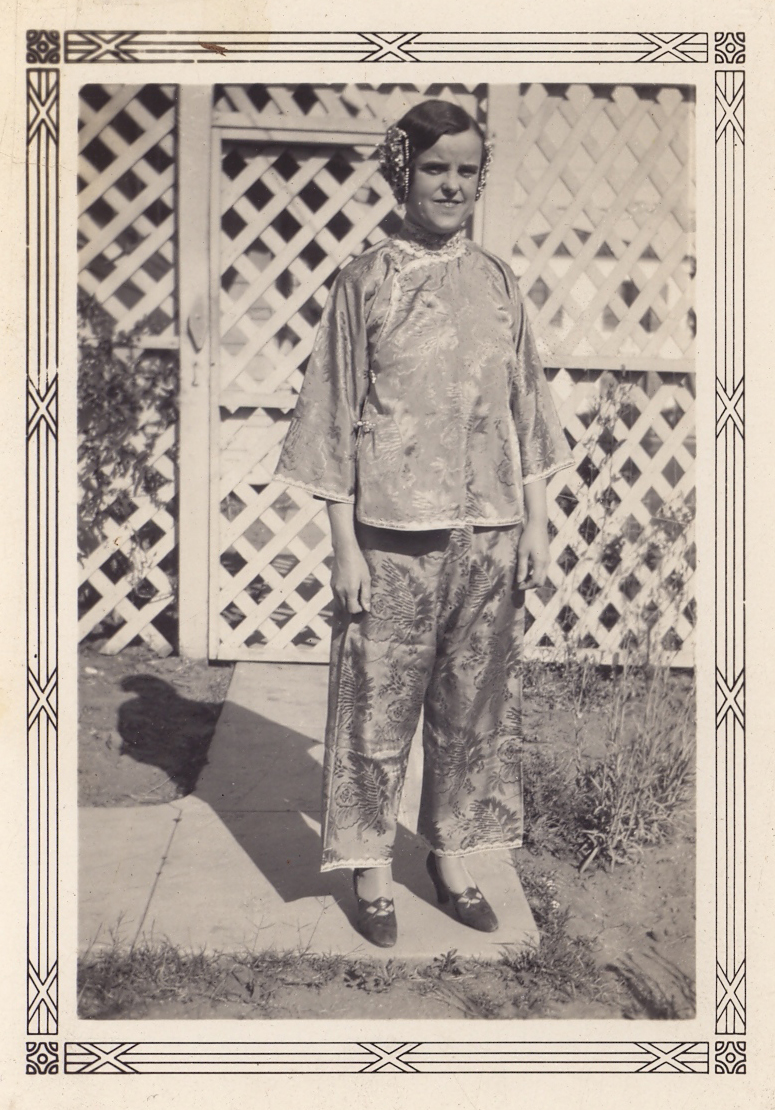
Dorothy in silk Chinese pajamas, late 1920s
Photograph and digital image in the possession of Susan Brubaker Knapp


Dorothy looking stylish on the rocks near Laguna Beach, California, late 1920s
Photograph and digital image in the possession of Susan Brubaker Knapp

Dorothy at Laguna Beach, California, 1920s
Photograph and digital image in the possession of Susan Brubaker Knapp
Dorothy, 1920s
Photograph and digital image in the possession of Susan Brubaker Knapp

Lynn and Dorothy, 1920s
Photograph and digital image in the possession of Susan Brubaker Knapp


Lynn and Dorothy, 1920s
Photograph and digital image in the possession of Susan Brubaker Knapp

Dorothy (left) with her mother-in-law and sister-in-law, 1920s; this may be Yosemite.
Photograph and digital image in the possession of Susan Brubaker Knapp

Dorothy, 1920s
Photograph and digital image in the possession of Susan Brubaker Knapp


Dorothy (left) with her mother-in-law and sister-in-law, 1920s
Photograph and digital image in the possession of Susan Brubaker Knapp


Dorothy, 1920s
Photograph and digital image in the possession of Susan Brubaker Knapp

Dorothy had two children with Lynn, Thomas Lynn Carter (born 1932) and my mother, Eleanor Ann Carter (born 1936).

Dorothy with Eleanor, 1936.
Photograph and digital image in the possession of Susan Brubaker Knapp
Dorothy with Lynn, Eleanor and Tom, about 1937.
Photograph and digital image in the possession of Susan Brubaker Knapp

Dorothy with Tom, about 1933.
Lynn and Dorothy with Tom, about 1935.
In 1938, Lynn died suddenly, and Dorothy returned to New Brighton, where she lived for some time with her mother-in-law, Agnes Loretta Warren Carter, and her sister-in-law, Miriam Carter. She worked hard, and long hours as a seamstress and a librarian, often working two jobs to keep her family afloat. Her obituary states that she worked as a librarian at New Brighton Library, and at Berkman’s Clothing Store in Beaver Falls. My mother used to tell me that her mother could see a dress or a coat, and then come home, make a pattern for it, and stitch it up. She made almost all of her own clothing, and my mom’s. 
Dorothy at her sewing machine, 1940s
Photograph and digital image in the possession of Susan Brubaker Knapp

Dorothy with Lynn, Eleanor and Tom, about 1945.
Photograph and digital image in the possession of Susan Brubaker Knapp
Here is a story my mother told me several times when I was a child. She wrote it down for my daughter Lea in 2004: 
“When I was about nine or ten, my mother, brother and I no longer lived at my grandmother's house; we had moved into a house of our own. In fact, it was the same house where my mother was born, way back in 1901. This was before most women went to hospitals to have babies. So it was about 1945 when this story happened. 

“My mother had to take care of the fire in the furnace, because we had no man in the family, since my father died when I was just a baby. She hated that furnace, because it required attention when she had other things she wanted to do. 

“One cold winter morning, she went down to see how the fire in the furnace was doing and found that it looked as though it had gone out. She was mad and in a hurry, so she looked around in our cellar and found a jar of kerosene. Now kerosene is very flammable. That means that if it comes into contact with fire it bursts into flame. She planned to put some coal in the furnace, sprinkle a little kerosene on it and carefully light it with a match to get the fire going fast. This was not a safe method. Usually one got the fire started slowly with some kind of kindling, like paper or small pieces of wood. 

“Well, when my mother sprinkled in the kerosene, unexpectedly there was a big BOOM! and the fire shot out. It sent out sparks and flames because there had been a small spark lurking under what she thought was a dead pile of ashes. 

“Now, my brother and I were up in the kitchen eating our breakfast and getting ready to go to school. We heard the boom and a scream from our mother. We ran to see her coming up the cellar stairs. She was all black, and all we could see on her face were her teeth and the whites of her eyes. The front of her hair was singed and her eyebrows, too. (Singed means burned a little but not flaming.) Her pretty white nylon blouse was sort of melted around her neck, and she probably would have been badly burned if she had not been wearing a heavy wool jacket and skirt. 

“The crazy thing was – she was laughing!! She just thought it was pretty funny that she had done such a dumb thing and then been lucky enough not to get badly hurt! So she took a bath, put on a clean clothes, and went to work. And for many years she would retell that story, and laugh and laugh!”
Me with Charlie Brandt, Dorothy’s second husband, about 1964
 In the 1960s, Dorothy was married for a short time to Charles Brandt, a farmer, but was very unhappy, and legally separated from him in 1964.  

Dorothy, whom I called “Nanny,” in the early 1970s.
Photograph and digital image in the possession of Susan Brubaker Knapp
Both my mother and father described her as a very open-minded person, and I remember her as a doting grandmother who loved me very much.

Me with my Nanny.
Photograph and digital image in the possession of Susan Brubaker Knapp

Dorothy died in 1981, after an illness of four months, of congestive heart failure. Lynn and Dorothy are buried in the Carter plot at Grove Cemetery in New Brighton.

Photo by Mark R. Brubaker, taken August 2013

Sunday, June 19, 2011

Henry George Paulson (1838-1898)

Henry George Paulson
Born: 1838 in Beaver County, PA
Died: March 20, 1898 in PA
Mother: Mary Hall 1806-?
Father: Adam/Alem/Elam Paulson, 1801-?
Wife: Julia Ann Alexander, 1935-1921

Children with Julia Ann:
1. Drusilla, 1857-?
2. Charles Hall, 1860-1927
3. Fanny Mary, 1862-1915
4. Joseph Fillmore Paulson, born May 21, 1867 in New Brighton, Beaver County, PA; died 1957

The following information is from Genealogical and Personal History of Beaver County, Pennsylvania (Volume 2) by John W. (John Woolf) Jordan:
“The Paulson family, of New Brighton, Beaver county, Pennsylvania, has been resident there for a number of generations, and in every generation they have proved their worth as good citizens and as valuable members of society.

(I) Henry Paulson was a machinist by trade. He married Julia Ann Alexander, born in New Brighton, Beaver county, Pennsylvania.

(II) Joseph Fillmore Paulson, son of Henry and Julia Ann (Alexander) Paulson, was born in New Brighton, Beaver county, Pennsylvania, May 21, 1867. He was educated in the public schools of New Brighton, and at an early age learned the trade of brick laying, with which he has been identified since he was sixteen years of age. He is a member of the United Order of American Mechanics, and the Knights of Pythias. Mr. Paulson married, December 8, 1887, Gertrude Drusilla Funkhouser, whose ancestral history follows this sketch. They have had children: Alma Gertrude, Carrie Marie, Lila Catherine, Ruth May, Lois Christine, Joseph Osman, Dorothy Eleanor, Cromwell Truby, Virginia Elizabeth, who died at the age of eight months.”
Henry’s life was troubled; he may have been an alcoholic or compulsive gambler. This quote is from the “Record of the Family Powelson” by Frank Wible Powelson:

“Henry Powelson (Paulson) married Julia Alexander of New Brighton, Penna. From reports told by the members of his own family, he must have been a rounder, because his wife divorced him and went back to her people. There were three or four children by this union. Henry married a second time and there was at least one son born, whose name could not be learned.”
Note: A “rounder” is an old-fashioned word that means someone who throws money away by gambling or drinking. Records show that he and Julia divorced in 1867, the same year that their fourth child, a son named Joseph, was born. Joseph is my great-grandfather. 

Henry is listed as one of inmates of Allegheny County, Indiana Township, county work house in 1870 in this document:  


He died on 20 March, 1898, two days after being run over by an ice wagon, in West Penn Hospital in Pittsburgh, PA. He was only 61 years old. The document below lists him as having lived most recently at 44- 30th Street, and having been buried on March 24, 1898, at Highwood Cemetery in Pittsburgh.


Gertrude Drusilla Funkhouser Paulson (1867-1936)

Gertrude Drusilla Funkhouser Paulson
Photograph and digital image in the possession of Susan Brubaker Knapp

Gertrude Drusilla Funkhouser Paulson
Born: 16 Sept. 1867 in New Brighton, Beaver County, PA
Mother: Catherine Ufferman, 1844-? born in Butler County, PA
Father: Jacob Osmon Funkhouser, 1839-1907, born in Beaver Falls, Beaver County, PA
Married Dec. 8, 1887
Husband: Joseph Fillmore Paulson, born May 21, 1867 in New Brighton, Beaver County, PA
Died : March 8, 1936

Siblings:
Caroline, b. 1863
Samuel Henry, b. 1869
Virginia May, b. 1871
Harvey Allen, b. 1876

Children with Joseph Fillmore Paulson (1867-1957):
Alma Gertrude Paulson, 1889-1970, married Samuel Ellsworth West
Carrie Marie Paulson, 1890-1984, married W. Marshall Cowsert
Lila Catherine Paulson, 1892-1971, married Gabe Thompson
Ruth Mae Paulson, 1894-1970, married John Thomas Wilson
Lois Christine Paulson, 1897-1985, married Seth W. Hulmes
Joseph Osmon Paulson, 1999-1947, married Mildred Irene Jones
Dorothy Eleanor Paulson, 1901-1981, married 1) Lynn McKee Carter and 2) Charlie Brandt
Cromwell Paulson, 1904-1979, married Etta Jones
Virginia Elizabeth, died at 8 months

Alma, Joseph, Dorothy, Ruth, Carrie, Osmon, Lila, Drusilla holding Cromwell, Lois 
Several times, my mother told me that her mother (Dorothy Paulson Carter) told her the following about Drusilla: She loved to read, and was often totally entranced with what she was reading, to the point that her many children were running around the house getting into all sorts of mischief, and she seemed not to notice. I was told many times by my grandmother that I resembled her, both physically, and because of my love of books.
Gertrude Drusilla Funkhouser Paulson
Photo in possession of Ruthann Wilbraham (via Ancestry.com)
Gertrude Drusilla with children (probably grandchildren)
Photo in possession of Jennifer 
Frum
Gertrude Drusilla Funkhouser Paulson
Photograph and digital image in the possession of Susan Brubaker Knapp


She is buried with her husband in Grove Cemetery, New Brighton, Pa.

Photo by Mark Brubaker, August 2013


Jacob Osmon Funkhouser (1839-1907) and Catherine Ufferman

Jacob Osmon Funkhouser (1839-1907)

Catherine Ufferman
Jacob Osmon Funkhouser
born Jan 10, 1839 in Beaver Falls, Beaver County, PA
Mother: Caroline Osmon/Osman, born 1808-1810, died 1880-1887
Father: Samuel Funkhouser, 1811-1861
First wife: Margaret Hays
Second wife: Catherine Ufferman (born 1844 in Butler County, PA)
Died 1907

Catherine Ufferman
born Feb. 1844 in Butler County, PA
Mother: unknown
Father: Charles Ufferman (b. 1822

Children of Jacob Osmon and Catherine:
Gertrude Drusilla
Samuel Henry
Virginia May
Harvey Allen
The following information is from History of New Brighton 1838-1939, published by the Historical Committee of the Centennial, Butler, PA, pages 30-32:

JACOB O. FUNKHOUSER was born in New Brighton on January 10, 1839. He learned the blacksmith trade with his father, but about 1866 associated himself with his brother, James Madison, and started a wagon and blacksmith shop at the corner of Sixth Avenue and Sixth Street. James Madison soon withdrew, and later Jacob O. changed to the tinning business which he pursued until he retired. In later life he served ten years as toll keeper at the Brighton bridge and died about 1907. Surviving him were Dallas, Caroline, Virginia M., Harvey A., Druscilla, wife of Joseph F. Paulson, and Samuel H. Funkhouser, all of New Brighton. Samuel H. has continued in the tinning business.”
The following information is from Genealogical and personal history of Beaver County, Pennsylvania (Volume 2) by John W. (John Woolf) Jordan:
“Jacob Osman Funkhouser, son of Samuel and Caroline (Osman)
Funkhouser, was born in New Brighton, Beaver county, Pennsylvania,
January 10, 1839, died in New Brighton. He learned the blacksmith's trade
under the supervision of his father, and worked with the latter until the
Civil War. Upon the conclusion of this struggle Mr. Funkhouser estab-
lished himself in this trade independently, later becoming a tinner, and when
he retired from this calling was toll taker at the bridge between New
Brighton and Beaver Falls for a period of ten years. He took an active
part in the public affairs of the community as an adherent of the Republican
party, and served as high constable and tax collector of the borough. For
a period of nine months he was in active service during the Civil War. He
was brought up in the faith of the Methodist Episcopal Church but later
affiliated with that of the Lutheran denomination. He was a member of the
Knights of Pythias. Mr. Funkhouser married (first) Margaret Hays, (sec-
ond) Catherine Ufferman, born in Whitestown, Butler county, Pennsyl-
vania, of German descent. Children by first marriage: Dallas, Caroline,
and an infant, the last mentioned dying young; children by second marriage:
Drusilla, who married Joseph Fillmore Paulson, of New Brighton, Penn-
sylvania ; Samuel Hendrick, of further mention ; Virginia May ; Harvey
Allen.”

Samuel Funkhouser (1811-1861) & Caroline Osmon (1810-1880)

Caroline Osmon Funkhouser (about 1810-1880)
Samuel Funkhouser
Born: Jan 4, 1811 in Beaver County, PA
Died: June 18, 1861
Mother: Nancy Ann Showalter (1778-1850)
Father: Jacob Funkhouser (1775- about  1840-50)
Wife: Caroline Osmon, born 1808-1810 in Beaver Falls, died 1880-1887

Children: 
Jacob Osmon, born Jan. 10, 1839 in Beaver Falls, died 1907
James Madison 
George Dallas
Charles
Denny
Samuel, died about 1884

The following information is from History of New Brighton 1838-1939, published by the Historical Committee of the Centennial, Butler, PA, pages 30-32:

“The first blacksmith shop in New Brighton of which there is definite record was that of SAMUEL FUNKHOUSER, which stood on Eighth Street upon the site now occupied by the First Baptist Church and was operated by him prior to 1837 and continued until after the Civil War. He was born in North Sewickley township of German ancestry, his father having been one of the first settlers north of the Ohio River. Samuel was a person of great physical strength.

“In his shop an episode had its inception which resulted in a tragedy and changed the name of a stream. One autumn day about 1845 a man whose oddly appearing garb indicated that he was an European appeared upon the streets of New Brighton and unable to understand him, sensing that he might be German someone directed him to Mr. Funkhouser’s shop. Mr. Funkhouser was known to speak German, but though he could not comprehend all the stranger said, he did understand that the man had been robbed at the market place in Pittsburgh, of most of his money. His clothing however indicated prosperity. Leaving the shop he was again seen about the streets for some time, teased by a coterie of small boys, one of whom was James Madison Funkhouser, son of the former Samuel, who related these particulars. But disappearing that evening the German was soon forgotten.

“In the early Spring of the following year some boys ascending Trough Run, the proper name of the third rivulet north of town, discovered the body of a man in the water, lodged against brush at what is known as the falls in that hollow. He had a hole in the side of his head, and was half frozen in the unmelted ice of the preceding winter. The wound was believed to have been caused by a sharp stick. When men were summoned, the corpse was identified by his garb as the odd appearing stranger seen on the streets of town some months prior thereto. He was never identified hut was buried in a rude box on the nearby hillside. Some years later an earth slide partially exposed the body. The pupils of the Bran Hill, now Thompson school, learned of what had just happened and they flocked down the hollow after dismissal to view the sight. Not knowing the correct name of the ravine they referred to it thereafter as the hollow of the dead man, so Trough Run became, though improperly “Deadman’s Hollow.” Tragedy entered the story, when it was revealed by a man on his death bed, a former town resident of unsavory record, that accompanied by another villager as derelict in morals as himself, they had killed the stranger. Thinking from his appearance that he had money they inveigled him, in some way, out the Mercer Road and into a thicket at the head of the ravine where they shot him in the side of the head. Finding nothing they cast the body in the run where it was washed down against the brush and lay there all winter.

“Mr. Funkhouser’s wife was CAROLINE OSMON who was born on her father’s farm on the site of Beaver Falls. He was an ex-English sea captain. The Funkhouser children were Jacob Osman, James Madison, George Dallas, Charles, Denny, and Samuel. James and Denny were veterans of the Civil War.

JACOB O. FUNKHOUSER was born in New Brighton on January 10, 1839. He learned the blacksmith trade with his father, but about 1866 associated himself with his brother, James Madison, and started a wagon and blacksmith shop at the corner of Sixth Avenue and Sixth Street. James Madison soon withdrew, and later Jacob O. changed to the tinning business which he pursued until he retired. In later life he served ten years as toll keeper at the Brighton bridge and died about 1907. Surviving him were Dallas, Caroline, Virginia M., Harvey A., Druscilla, wife of Joseph F. Paulson, and Samuel H. Funkhouser, all of New Brighton. Samuel H. has continued in the tinning business.


“The second Samuel Funkhouser mentioned, brother of Jacob O. will be remembered by all of the older residents and many Ft. Wayne railroad men not residents. He was a short, extremely strong man with the singular formation of 12 fingers and 12 toes, and for at least 15 years was daily on the streets delivering light freight and baggage from the New Brighton railroad station to local consignees. He used a two wheeled hand cart in which he sometimes pushed loads that were worthy of the strength of a dray horse, often singing as he trod the pavement.


“He had a pleasing personality and an excellent singing voice which he exercised frequently. For these reasons and his physical peculiarity the trainmen nearly all knew him. Upon one occasion when the train bearing the famous singer, Jennie Lind, stopped at the station, the railroaders persuaded Samuel to sing for her and held the train until he finished. He was somewhat embarrassed when she complimented him upon the sweetness of his voice. He died about 1884.

Richard Baxter McDanel

The McDanel family, probably around 1900
Photograph and digital image in possession of Susan Brubaker Knapp
This is a photo of my great-great-grandparents, Richard Baxter McDanel and Lydia Ann Marquis McDanel, and their children. Richard and Lydia are the two older people seated, and my great-grandfather, Frederick, is in the back row on the left, with the wonderful mustache. A distant cousin has written me and identified her relation, Bertha, as the daughter seated on the far left. Here is a close-up shot of Richard taken from the photo above:


Richard Baxter McDanel
Born September 4, 1844 in North Sewickley Township, Beaver County, PA
Died November 21, 1912  in Beaver County, PA
Father: Abram McDanel, born 1802 New Brighton, Beaver Falls, PA. Died 1853 or 54
Mother: Hulda Hasen
Siblings: William, Samuel, Mary, Isaac
Wife: Lydia Ann Marquis McDanel, (1842-1928)
Buried in Grove Cemetery, Beaver County

Children of Richard Baxter McDanel and Lydia Ann Marquis McDanel:
1. Frederick born Sept. 1, 1868. Married Effie Braden. Children: Marion and Helen
2. Lewis (died young)
3. Bertha – Married Henderick LaVern Heesen
4. Frank S.
5. Orrin Palmer, born Feb. 8, 1879
6. Richard B.
7. Elizabeth – Married S. S. McCudy
8. Anna – Married A.C. Kirk

In Genealogical and Personal History of Beaver County Pennsylvania, Volume II, (1914) author John W. Jordan writes:
“Richard Baxter… attended the public schools of New Brighton, but had not yet completed his education when active hostilities between the North and South broke out. Closing his school books, he hastened to enlist as a private in Company C, 63rd Regiment Pennsylvania Volunteers, although he was compelled to add a year to his age to gain admission to the ranks. His term of service began in 1861 and continued three years, during which period he engaged in some of the bloodiest and most hotly contested conflicts of the war, deporting himself under all conditions as a gallant and brave soldier.

“Returning to Beaver County, he searched among the arts of peace for a suitable and congenial occupation, and finally deciding to learn the carpenter's trade. This he did, and from journeyman employment became the proprietor of a lumber and planing mill. Controlling, as he did, a source of supply, and with a thorough practical knowledge of his trade, he engaged in contracting and building. Beginning under such favorable circumstances, his enterprises met with profitable success, and he became one of the most prosperous business men of the county. Honorable dealing and strict consideration for the wishes of those for whom he was conducting operations gained him many clients, and universal satisfaction followed his extensive dealings.

“With the capital acquired in this line he entered the field of oil producing and in this, as in his previous experience, he prospered, acquiring a comfortable competence.  He was a shrewd financier, far-sighted and conservative in his investments, and during his connection with the Union National Bank as director was largely responsible for the successful career of that institution.

“For over forty years he was a member of the Methodist Protestant church, to which his wife and children also belonged and for many years of that period was a member of the official board. He married, March 19, 1868, Lydia, daughter of James and Elizabeth (Sawyer) Marquis, the Rev. H. Colhoner, of the Methodist Protestant church, performing the ceremony.”

R.B. McDanel Co. lumber, after the Beaver River flooded March 27, 1913.
Photograph and digital image in possession of Susan Brubaker Knapp
The clipping below is from an unknown source, given to me by a distant cousin who is the grand-daughters of Bertha McDanel, R.B. McDanel’s daughter. It has photos of Baxter, and four of his sons (Frederick, Frank, O.P., and R. B., Jr., who helped run the company, as well as a gorgeous interior staircase from a residence, and the exterior of an unidentified church (the caption may be cut off).


A closer shot of R.B. McDanel, Sr. from the clipping
Text from the clipping: R. B. McDanel & Sons, contractors and builders, located on the corner of First Avenue and Eleventh Street, New Brighton, are among the best in their line in western Pennsylvania. R. B. McDanel, the head of the firm, served three years in the 63rd Pennsylvania Volunteers in the rebellion, and was discharged in Pittsburg in 1865. He then went to work at anything that turned up, finally drifted into the carpenter business, learned the trade, and in 1876 started in business as a contractor and builder. In 1880 he associated with Hiram McClain and started a planning mill, under the firm name of McDanel & McClain. During the ten years of their business career together they did a large business, extending from Eastern Ohio to Pittsburg and Allegheny. In 1890 R. B. McDanel purchased the interest of Mr. McClain, and since [then] the business has been run under the firm name of R. B. McDanel & Sons, taking in the boys as soon as they were through school. They are all graduates of one or more colleges, but that did not make them afraid of hard work, as each one started in the business at the bottom and is working his way to the top and success if hard work and close …in business will do it. The firm keeps abreast of the times by constantly adding the latest machinery to the plant, and employing the most skilled mechanics. A run through their mill shows they are giving a great deal of attention to fine finish and stair work, nearly one-half of the space in their large plant being taken up with that class of work. …in this line is demonstrated by the fact that they have built stairs in some of the finest residences in Beaver, Rochester, Beaver county and also in the Sewickley valley…The also do a large business in slate and slate roofing, keeping always on hand slate of all kinds. They will make your plans and specifications and take a contract to build your house from cellar to finish, or any part of it in their line, and you can rest assured that the work will be managed by competent men.

Caption under interior shot: Interior of A.S. Mease’s (?) residence, Beaver, PA, R. B. McDanel & Sons, Builders

Internet records for Company C (“recruited at Pittsburg”) indicate that Richard “mustered in” on August 1, 1861 as a Private, served for three years, and “mustered out with Company, August 1, 1864.”
“Company C was organized in New Brighton, Beaver County, in the early part of August 1861. After completion of organization the company left New Brighton for Pittsburgh, Pa., amidst a large delegation of prominent citizens: fathers, mothers, brothers, sisters, wives and sweethearts bidding a sad farewell to their loved ones.

“After arriving in Pittsburgh, the company went into camp at Camp Wilkins. In a short time orders were received that all men should be sent to Washington, D.C. Accordingly, on the 26th of August, two companies, under command of Captains Berringer and Kirkwood, and several squads temporarily organized in two additional companies, in all about four hundred men, including Company C, proceeded by rail to the National Capital without arms, uniforms, or equipments.

“During the early part of September 1861, a sufficient number of men had arrived in camp to complete a regiment, and toward the close of the month were transferred to Washington, where they joined the battalion which had preceded them. Their first camp was known as Camp Sprague. On September 28th they crossed the Potomac, and landing at Alexandria, Virginia, marched about two miles out the Leesburg Pike, where they encamped at what was known as Camp Shields. On October 14th they again moved, going across Hunting Creek to the farm of James Mason, on the Mount Vernon Road, and into winter quarters at Camp Johnston. From there they embarked on transports for Fortress Monroe, and began the memorable Peninsular campaign, followed with subsequent campaigns to the expiration of their term of service, September, 1864.

“Known as the “Hanna Guards”, the officers of Company C were:
  • Jason C. Hanna, Captain
  • Jos. A. Schonlaw, First Lieutenant
  • Charles W. Taylor, Second Lieutenant
  • Henry Hurst, First Sergeant”
Source:   Gilbert Adams Hays, Captain. Under the Red Patch: Story of the Sixty-third Regiment Pennsylvania Volunteers, 1861-1864. Published by the 63d Pennsylvania Volunteer Regiment Association. Pittsburg: Market Review Publishing Company, 1908.
letter written 26 December 1861 by Richard “Baxter” McDanel
Document and digital image in possession of Susan Brubaker Knapp
 The following is my transcription of the letter shown above:
26 December
Camp Jonston [Johnston]
I receved [received] your letter to day and was glad to hear from home [.] we ar [are] all well at preasant [present] [.] we had a nice day Chris mus [Christmas] if a person did not cair [care] what he said[.] we was routed out of bed that morning about 4 oclock [o'clock] and we started to Pohiek [Pohick Church, VA] once more and when we got their [there] they the rebbles [rebels] I mean had left[.] I supose [suppose] they wanted to draw us in to a trap but they was not sharp enough[.] we staid [stayed] there about to [two] hours when they shoad [showed] them self [themselves] on ahil [a hill] about to [two] miles off[.] when our artilery [artillery] threw a shel [shell] among them they scatered [scattered] like sheap [sheep] but they wood not fight[.]

So we had to come home and you may juge [judge] whether their [there] was enny [any] swerring [swearing] or not for we had thirty miles to march through as mudy [muddy] roads as ever you seen[.] So you know what kind of a Chris mus [Christmas] we had and I supoze [suppose] that new years will be the same and I expect that we will git [get] paid about the fifth of next month after the hollow days [holidays] or over and if thur [there] is a Box coming soon you will oblige me by sending a bottle off [of] Whisk [Whiskey] for I hant [ain't] had nothing to drink since I came out hear [here][.] the Boys are all giting [getting] fat sinc [since] cold wheuther [weather] came and iff [if] I ant [ain't git in [getting] fat I arta [ought to] for I eat all my ration at to [two] meals and have to buy grub for the other[.]

you wanted to know about that Box[.] well I was on gard [guard] the day it came and I did not see enny [any] but my one and it was all right and I did not hear enny Buddy [anybody] complaining I am very mutch [much] obliged to uncle for that to Baca [tobacco] he sent me[.]

well I havnt [haven't] got mutch [much] to say this time[.] we ar [are] giting [getting] along verry [very] well[.] we have one drill a day and that last [lasts] from six in the morning til Supertime [suppertime] So we have to wright [write] after knight [night] and if you cant [can't] read it you must not blame me[.] Give my best respects to all the girls[.]
Br McDanel
The following information is copied from the website for the 63rd Regiment of Pennsylvania Volunteers:
During the late summer of 1861, one hundred men from Beaver County, Pennsylvania banded together and enlisted en masse in the United States Army.  Their aim was to preserve the United States by helping to put down the confederacy.  This military unit was first called "Hanna's Light Guards," named for their commanding officer.  Later, they mustered in as Company C of the 63rd Regiment of Pennsylvania Volunteers.
The regiment embarked for Washington in August of 1861 and remained in camp there, transforming themselves from citizens into soldiers.  During this time recruiting continued in Pittsburgh until the regiment reached a full compliment of one thousand men.
The first time the men faced their enemy occurred at an obscure place called Pohick Church, Virginia. Three men were killed in this fight.  The regiment did not fare as well at all other battles for the remainder of the war.
The 63rd Pennsylvania embarked on General George McClellan's Peninsula Campaign during the spring of 1862.  Here, they fought in the Battles of Fair Oaks, Williamsburg, Yorktown, and Malvern Hill.  The 63rd lost one half of its men to battlefield casualties and disease during its first year of service.
The 63rd next participated in the Second Battle of Bull Run. At this engagement, the men charged an unfinished railroad cut that a rebel brigade had taken refuge behind.  After charging this position three times, the regiment finally gave ground. Of three hundred and fifty men who went into this fight, seventy-eight remained to answer roll call that evening. Among the casualties was Colonel Alexander Hays, who was severely wounded.
The next battle in which the 63rd found itself was at Chancellorsville. The regiment lost over one-third of its men through their valiant fight at this engagement. During the Battle of Gettysburg the 63rd found itself on the front lines and performed gallantly throughout the second day's fight.  Alexander Hays, now promoted to the rank of General, commanded a division that helped throw back the ill-fated Pickett's Charge.
During the fall of 1863, the 63rd received a large number of drafted men to swell its depleted ranks.  However, it never again reached the 1,000-man strength it had just sixteen months before.
During the spring of 1864, the regiment participated in General Grant's overland campaign to take Richmond.  They fought in the Battles of the Wilderness, Cold Harbor, Spotsylvania, and Petersburg.
On September 9, 1864, the three-year term of enlistment for the 63rd Pennsylvania officially ended, and the men were mustered out of service.  Of the one hundred and three men who left Beaver County in 1861, thirteen remained present for duty.  One dozen of their comrades, who made up the remainder of the company, lay seriously wounded in field hospitals.
I’m not sure if I have all my facts straight yet, but it looks like Richard’s great-grandparents, Rachel (1750-1824) and Archibald McDanel (1751-1819), immigrated to America from Scotland sometime before the Revolutionary War.

Friday, June 17, 2011

Lynn McKee Carter

Lynn McKee Carter (1901-1938)
Photograph and digital image in possession of Susan Brubaker Knapp
Lynn McKee Carter
Born in Beaver County, PA, Sept. 19, 1901
Died in San Francisco (Stanford Hospital); lived in Los Angeles, CA, Jan. 18, 1938
Mother: Agnes Loretta Warren (1877-1951)
Father: Thomas Lynn Carter (1870-1913)
Wife: Dorothy Eleanor Paulson Carter (1901-1981), married Jan. 6, 1925
Children: Thomas Lynn Carter (born 1932) and Eleanor (Carol) Ann Carter (1936-2011)

Lynn’s only sibling was:
Miriam Leedom Carter (born 1904)

Lynn in 1901 or 1902
Photograph in possession of Bob Brubaker

Lynn in 1901 or 1902
Photograph and digital image in possession of Susan Brubaker Knapp
Lynn (on right) and a cousin, believed to be Warren E. Brashears (son of Hannah Warren), 1901 or 1902
Photograph and digital image in possession of Susan Brubaker Knapp

Lynn and his sister, Miriam
Photograph and digital image in possession of Susan Brubaker Knapp
In 1913, when Lynn was only 12, his father (Thomas Lynn Carter, who was working as a carpenter) died suddenly after a fall from a scaffolding.


Lynn and Miriam with their mother, Agnes
Photograph and digital image in possession of Susan Brubaker Knapp
Lynn, probably mid 1910s
Photograph and digital image in possession of Susan Brubaker Knapp
Lynn grew up in New Brighton and graduated from New Brighton High School in 1920.

Lynn’s pocketknife, engraved with his initials and high school graduation date
Pocketknife and digital image in possession of Susan Brubaker Knap
He married Dorothy Eleanor Paulson on January 6, 1925, and they moved to Los Angeles soon afterward.
Lynn and Dorothy, late 1920s or 1930s
Photograph and digital image in possession of Susan Brubaker Knapp

Lynn in his front yard in Los Angeles, 1920s or early 1930s
Photograph and digital image in possession of Susan Brubaker Knapp
In 1992, Robert L. Carter sent me the photo of Lynn shown above. Robert is son of Robert Lymon Carter (b. 1888), who was Lynn’s uncle. He wrote that his parents spoke highly of Lynn, said that he was very bright, and remembered that he had grown a mustache when he lived in Los Angeles, so that he would look older and more managerial, as he was young for his position in the company. As you can see from the photograph with Dorothy, he was very tall, about 6'4", according to my mother. Dorothy was shorter than 5'. He had curly reddish-brown hair and blue eyes.

My grandmother, Dorothy, loved living in Los Angeles, which must have been very exciting and glamorous in the 1930s. I remember her talking about the orange trees that grew in the backyard of their home at 1172 Browning Boulevard.

Lynn and Dorothy had two children: Thomas Lynn Carter (born 1932) and Eleanor Carol Ann (born 1936). 
Lynn and Dorothy with Eleanor and Tom, Los Angeles, probably 1937
Photograph and digital image in possession of Susan Brubaker Knapp
This is Lynn with his son Tom in Los Angeles, around 1933
Photograph and digital image in possession of Susan Brubaker Knapp


The letter below, sent from Lynn to his mother, Agnes Warren Carter, in New Brighton, after the birth of Eleanor in 1936, shows that he was very pleased to be a father:
Document and digital image in possession of Susan Brubaker Knapp

Document and digital image in possession of Susan Brubaker Knapp

Document and digital image in possession of Susan Brubaker Knapp

It reads:
Dear Mother and Miriam:

What did you think when you received the telegram? Weren't you thrilled! We're so happy to think w have a little girl. Dorothy is the happiest person in the world. We haven't named her to date. She's a little dear, round plump face black hair and it seems sort of kinky (maybe it is going to be curly). She has quite a bit of hair too. She looks like Dorothy I think. She has the prettiest coloring, not the least bit red like most new born babies. Her head is so pretty for a new baby.
About eight o'clock Tuesday evening Dorothy started having labor pains and by 9:15 we were in the hospital. Things started to happen quickly and by 11:20 P.M. April 14th the baby was born. Dorothy didn't have the least bit of a hard time like she did when Tommy was born. It was all over in two hours. This morning when I went into her room she was all dressed in a pretty nightie and said she felt like getting up. She said it seemed too good to be true that it was all over and she had a baby girl. We had hoped from the first it would be a girl but we couldn't let ourselves think that sure it would be a girl. We even went so far to select a boys name (John) but sort of stayed clear of a girls name and the result is we are 100% sure of what we'll call her.
She's a little doll and believe you me we're the proudest parents that ever lived. Just think having a nice boy like Tommy and then to be blessed with a lovely daughter. Dorothy looks like a queen lying there in her bed. She has a lovely private room, the service is wonderful, and I'm sure everything will continue to be O.K.
Tommy is thrilled with his little sister. He wants to see his mumie. Poor little fellow was in bed all day to-day with a cold. He ate too many candy easter eggs on Easter and it upset him. We have a nurse here who will take complete charge of everything. She is engaged for two months and by that time Dorothy will be alright I’m sure. I want her to take it easy and not rush things.

I was walking around in the clouds to-day. I really was proud to be the father of a boy and a girl.

Please tell Dorothy's sisters all the news as I'm too busy to write them. Dorothy will appreciate a letter from them. She misses her mother and maybe this dear little girl will take her place.

With all our love, Lynn

(Tom’s much better to-nite; he will be up and around this morning.)
 
From the photos I have, it looks like Dorothy and Lynn traveled extensively in the western United States, and were sometimes joined by Lynn’s mother, Agnes Loretta Warren Carter, and his sister, Miriam.

Lynn with cacti, probably 1930s
Photograph and digital image in possession of Susan Brubaker Knapp
Lynn (top) and Dorothy (fourth from bottom) headed down the Grand Canyon, July 1928.
Photograph in possession of Bob Brubaker; digital image: Susan Brubaker Knapp
Lynn worked for McClintic-Marshall Steel Company (later purchased by Bethlehem Steel) as an engineer. He worked on two important projects in California: Los Angeles City Hall, and the Golden Gate Bridge in San Francisco.


Lynn in front of the construction site for the Los Angeles City Hall, about 1926.
Photograph and digital image in possession of Susan Brubaker Knapp
This postcard was among Lynn’s mementos.
Document and digital image in possession of Susan Brubaker Knapp
This postcard was among Lynn’s mementos.
Document and digital image in possession of Susan Brubaker Knapp


This stadium pass to the 1932 Olympics in LA was among Lynn’s mementos.
Document and digital image in possession of Susan Brubaker Knapp


Lynn died at age 36 at Stanford Hospital in San Francisco. My uncle Tom (Lynn’s son) says his premature death was due to “malignant hypertension,” and that doctors were going to operate on him, but he died before the surgery could take place. After a service at at the First Methodist Episcopal Church in Los Angeles (where he had attended while living there), his body was brought back from Los Angeles via train, and his funeral was held at First Baptist Church in New Brighton. He was buried in Grove Cemetery.


Photo by Mark R. Brubaker, taken August 2013